

Almonds & walnuts are the anchor of Bays Ranch
Bays Ranch uses almonds, walnuts and annual crops to balance production in California. Explore its irrigation methods and examine its farming strategy.


Key takeaways
- Bays Ranch operates roughly 2,000 acres in Stanislaus County, California, with more than 1,200 acres devoted to nuts.
- Almonds and walnuts account for 50% to 60% of the ranch’s crop portfolio.
- The operation uses surface water, groundwater and water-banking strategies alongside multiple irrigation systems.
- Automated pump controls, GPS tracking and monitoring platforms support efficiency and management.
- Annual crops help provide cash flow while young orchards mature and nut-crop payments are pending.
- The family operation employs about 30 people nearly year-round and spreads labor needs across different harvest seasons.
Diversification has helped Bays Ranch adapt to the realities of California agriculture for nearly seven decades. The roughly 2,000-acre farm in Stanislaus County grows almonds, walnuts, apricots, processing tomatoes, lima beans, wheat, melons, olives and cling peaches. Overall, more than 1,200 acres are devoted to nuts, with almonds and walnuts accounting for 50% to 60% of the crop portfolio.
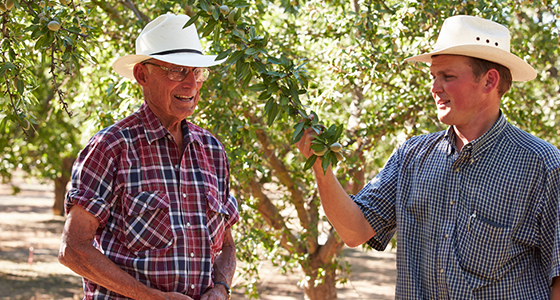
Daniel Bays, a third-generation farmer, runs the day-to-day operation with his father, Ken. His grandfather, Gene, remains part of a family legacy that began in the area in 1957.
“My grandfather farmed down in southern California in Ventura County with his grandfather,” Bays said. “In the late 1950s, he got pushed out by development and moved to where we’re at now. Initially, he was farming row crops. Then, in the early ’60s, he started planting apricots, almonds and walnuts.”
The family’s experience with walnuts in Ventura County made the crop a familiar choice, while almonds offered another way to diversify. Over time, both crops’ economics and ability to be mechanically harvested made nuts increasingly important to the operation.
“When Grandpa first started farming, you were picking up walnuts by hand, knocking almonds onto tarps and hauling them out of the field,” Bays said. “We’ve grown through that evolution of using mechanical shakers and sweepers and pickup machines. As labor has become a bigger challenge and expense, those crops have been very appealing because you can harvest and farm a lot of acres with a relatively small labor force.”
Bays Ranch employs about 30 people nearly year-round, and its mix of permanent and annual crops spreads work across the calendar.
“It works well spreading out our harvest between the different crops and being able to have steady work for our employees throughout the year,” Bays said. “They’re able to stay at one place and collect a regular paycheck. They’re not having to bounce around, following crops or going from farm to farm looking for work.”
Matching irrigation to the field
Bays earned a degree in bioresource and agricultural engineering from California Polytechnic State University before returning to the farm. Irrigation, equipment and personnel management are now central to his role.
“When we first started out, it was all flood and furrow irrigation, and water was run on a concern,” he said. “That’s obviously changed over time, and we’ve changed and evolved with it — from furrow to sprinkler to micro-sprinkler to drip.”
The farm uses surface water, groundwater and water-banking strategies, but Bays cautions against treating any technology as a universal answer.
“We’ve found there’s not necessarily a silver bullet,” he said. “You have some soil types and fields where a full-coverage sprinkler is what you need, and other times micro-sprinkler is a better fit, or it might be a double-line drip. Each one of those has pros and cons.”
Soil- and crop-monitoring platforms provide another view of conditions in the orchard, but they complement rather than replace direct observation.
“We still go out with a shovel and get our hands dirty,” Bays said. “Having that sensor to look back at really helps and is another set of eyes out there for us.”

Technology supports the team
Automated pump and valve controls help match irrigation to crop demand. GPS trackers on equipment reveal adjustment, training and efficiency opportunities.
“As we’ve grown in those economic of scale and efficiency, having that extra set of eyes helps my dad and I keep a better pulse on things,” Bays said. “We’re just one or two people, and we can’t do it all ourselves. There’s also a lot more demand for the farmer in the office doing paperwork, compliance and recordkeeping.”
Bays has developed his industry perspective through leadership programs with Blue Diamond Growers, the Almond Board of California and the California Farm Bureau. At home, responsibility is also distributed among supervisors focused on irrigation, equipment maintenance and field operations.
A tomato processing partner handles that crop’s harvest, allowing the Bays team to concentrate on almonds and walnuts when the schedules overlap.
Diversification spreads risk
Annual crops provide cash flow while young orchards mature and before pooled nut-crop payments are complete. Established nut crops can also offer stability alongside crops with sharper swings in yields, weather and pricing.
“The diversification helps in a lot of ways,” Bays said. “With an orchard, you have several years of development where you’re not really getting a return. The row crops and some of the fruit crops help with that cash flow. The almonds and walnuts have been good at helping balance the overall operation.”
He sees room for optimism because almonds require a Mediterranean climate and can be grown commercially in a few regions. California’s transportation network and port access also support domestic and export markets.
For the family, growth must make economic and operational sense. Bays Ranch may not be the first to try every idea, but it learns from neighbors, industry groups and employees.
The work remains appealing because it combines production with constant problem-solving, Bays said. Its deeper reward is the opportunity to carry forward a family enterprise.
“What other opportunity would I have to work with my dad and grandfather and have my own children out there with me on a daily basis?” he said. “It’s long days and dusty days, hard work and not always real profitable, but the good times outweigh the bad.”
All photos courtesy of Bays Ranch.
FAQ
What crops does Bays Ranch grow?
Bays Ranch grows almonds, walnuts, apricots, processing tomatoes, lima beans, wheat, melons, olives and cling peaches.
Where is Bays Ranch located?
Bays Ranch is located in Stanislaus County, California, and operates approximately 2,000 acres.
How does Bays Ranch manage irrigation?
The ranch uses surface water, groundwater and water-banking strategies, with sprinkler, micro-sprinkler and drip irrigation selected according to field conditions.
What technology does Bays Ranch use?
The operation uses automated pump and valve controls, GPS equipment tracking and soil- and crop-monitoring platforms.
Why does Bays Ranch diversify its crops?
Diversification helps balance cash flow, spread labor requirements across the calendar and manage fluctuations in yields, weather and pricing.
A graduate of the University of Miami, Keith Loria is an award-winning journalist who has been writing for almost 20 years. View his recent writing at keithloria.contently.com.