

Innovation, stewardship and long-term orchard success in California
California almond grower Donny Hicks shares lessons on innovation, irrigation and orchard stewardship. Explore practical insights and discover proven strategies.


Key takeaways
- Donny Hicks has more than 25 years of almond farming experience while serving in grower relations for RPAC.
- His family converted former peach acreage into almond production beginning in 1984.
- Hicks emphasizes winter sanitation as a primary defense against navel orangeworm.
- Irrigation monitoring and fertigation help improve water and nutrient management.
- Hicks believes drones and cover crops both offer opportunities to improve orchard management.
- He encourages growers to balance proven practices with emerging technology.
Donny Hicks, an almond grower from Hughson, California, has more than 25 years of almond farming experience. Today, he combines firsthand production knowledge with his role in grower relations for RPAC, while managing his own 18-acre almond orchard, D&O Orchards.
“I sometimes tease, you have boutique wine growers, so I’m kind of the boutique almond grower,” Hicks said.
That grower-first perspective carries into his role in grower relations at RPAC, where he represents nearly 6,000 acres of almond production.
From peaches to almonds
Hicks grew up in orchards, having spent time on his grandmother’s peach orchard as a child. Hicks said Hughson was once the peach capital of the world, in fact, D&O Orchards was at one point a peach orchard. His wife, Olivia, grew up on the same land, and when her family originally bought the acreage to harvest corn and oats as forage for their dairy farm, it was converted from a peach farm. In 1984, the family planted its first crop of almonds.
“As I came in, the family was on their way out, so we took out all of the old trees and started all over again,” Hicks said. Hicks steered away from planting traditional varieties that require cross-pollination, and opted instead to plant self-compatible trees: Independence and Shasta.
A small grower perspective still matters
Although Hicks manages a relatively small orchard, he said operations of every size can learn from one another. Many of the same challenges and solutions apply regardless of acreage.
“I farm too, even though it’s on a smaller scale. You’re still doing the same thing as the big guy,” Hicks said.
Even with a smaller operation, there are still many concerns almond growers are trying to manage. Almond growers of every size face challenges ranging from water availability and Sustainable Groundwater Management Act (SGMA) regulations to navel orangeworm and red leaf blotch.
While Hicks isn’t as worried about water availability and SGMA regulations due to his specific zone, pests and fungus remain a concern.
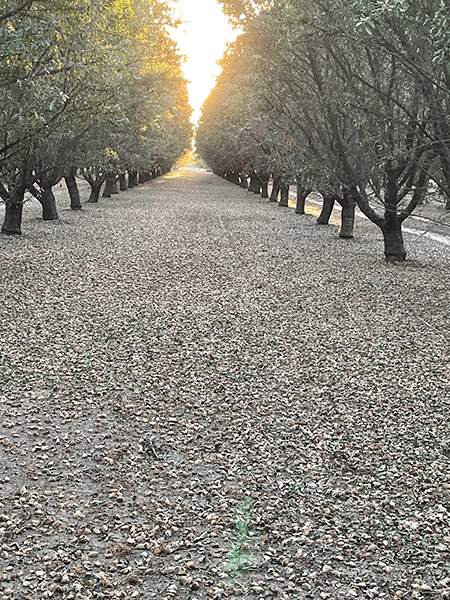
Navel orangeworm is the biggest problem in the industry, Hicks said, but the best way to minimize the problem starts with sanitation. After harvest, there’s a percentage of nuts that don’t come off the tree, which can provide a place for the navel orangeworm to lay eggs. To reduce navel orangeworm pressure, Hicks performs a winter shake to remove remaining “mummy” nuts before sweeping and destroying them. This limits overwintering habitat and helps reduce infestations by hull split, when a new crop becomes most vulnerable.
“We preach this: You can’t spray your way out of it; you’ve got to winter sanitize. It takes a little bit of extra work and I’ve seen the benefits from it,” Hicks said.


Tech that helps growers
Many advances in agricultural technology aren’t just about what’s new, it’s about making better management decisions when it comes to crops. With water access remaining a top concern for almond growers, there are several technological advancements growers can utilize to assist their orchards.
One of the biggest advancements to Hicks’ operation has been irrigation monitoring.
“I use a service called Gradient. They give me daily readings from the probes down in the ground. It monitors how much water I apply through my drip system and it’s able to tell the stress on the canopy,” Hicks said.
Combined with evapotranspiration (ET) data from local weather stations, the Gradient system allows him to fine-tune irrigation schedules based on current conditions rather than historical averages.
Advancements in technology have also helped nutrient management. Hicks uses fertigation, injecting nitrogen and micronutrients directly through his drip irrigation system to increase plant uptake efficiency while reducing nutrient losses below the root zone.
Invigorating innovations
While Hicks operates a relatively small orchard, he closely watches emerging innovations that can improve production across the industry. One advancement that excites him the most is the use of drones applying fungicides in orchards. Although drones are already being used to apply fungicides during bloom, Hicks said they show promise for targeted navel orangeworm applications as well.
“We’re thinking that it could be a good thing for applying navel orangeworm sprays in the upper canopy. When applied during bloom when you have tiny leaves, it blows it right down onto the tree,” Hicks said.
Not every advancement is rooted in technology. According to Hicks, one practice that has significantly improved long-term orchard health is the use of cover crops. Through Project Apis m., many growers are initially attracted to cover crops for their pollinator benefits, but quickly recognize potential for improving soil structure, water infiltration and organic matter. Hicks said he would love to see more growers adopting cover crops into their orchards despite planning for their termination creating a bit more work.
Hicks believes successful growers will continue balancing proven practices with new technology. Whether experimenting with cover crops or evaluating emerging technologies like drones, Hicks encourages growers to remain curious and stay informed.
“As an almond farmer, you’re not only growing this year’s crop — you’re always looking to the future of next year’s crop as well,” Hicks said.
Photos courtesy of Donny Hicks.
FAQ
Who is Donny Hicks?
Donny Hicks is an almond grower from Hughson, California, who manages D&O Orchards and works in grower relations for RPAC
What varieties does Hicks grow?
He planted self-compatible almond varieties including Independence and Shasta.
How does Hicks manage navel orangeworm?
He emphasizes winter sanitation by removing and destroying mummy nuts after harvest.
What technology does Hicks use for irrigation?
He uses the Gradient irrigation monitoring service together with ET data to manage irrigation scheduling.
Why does Hicks support cover crops?
He says cover crops improve soil structure, water infiltration and organic matter while also benefiting pollinators.
Gabrielle Rippel is a freelance writer with experience in multiple industries. Check out her recent work at getagrippel.com.
National Nut Grower