

Precision spraying: Beyond pesticide reduction
Pistachio trials are testing LiDAR-guided spraying at up to 400 GPA, with measured spray reductions ranging from 30% to 64%.





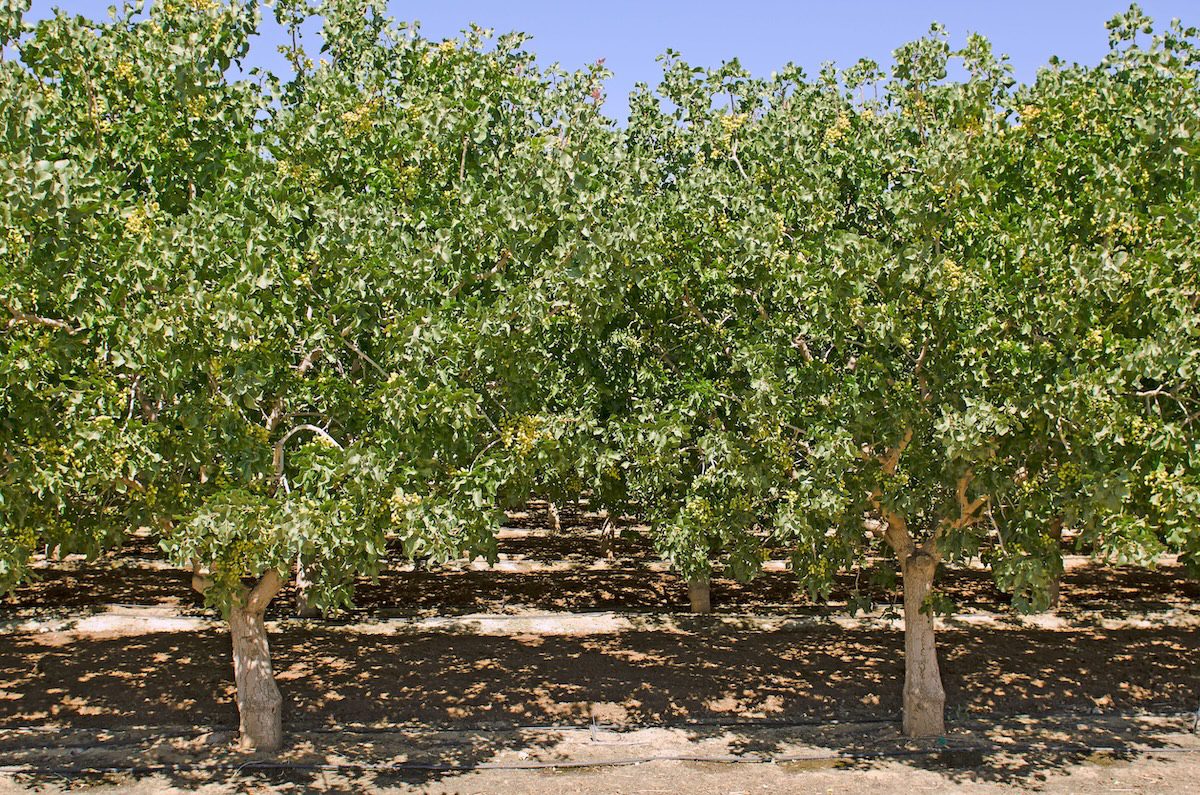
Over the past few years, much of the conversation around precision spray technology has focused on one question: How much pesticide can we avoid applying without sacrificing pest control?
That remains important, but recent American Pistachio Growers, USDA-ARS and UC Cooperative Extension research is raising another question. What if precision spraying not only reduces unnecessary pesticide use, but also makes spray volumes and application strategies practical that previously were not operationally feasible?
APG has spent several seasons evaluating sustainable spray technologies under commercial orchard conditions. For the past two seasons, that work has included LiDAR-guided orchard spraying. Our research currently uses the Smart Apply system, but the larger concept is canopy-sensing precision application: LiDAR identifies tree canopy and controls individual nozzles so material is directed toward the target rather than gaps and open space.
Previous APG trials have demonstrated spray reductions of roughly 55% to 60% in mature pistachios at 200 gallons and similar reduction at 100 gallons on younger trees, while mature almond research showed approximately a 50% reduction. Importantly, USDA-ARS research entomologist Joel Siegel’s navel orangeworm (NOW) bioassays have generally shown very high control. Individual observations have sometimes been numerically lower, but overall efficacy has remained comparable to conventional applications.
Reducing pesticide use means little if we compromise pest control.
Rethinking 200 gallons
For years, 200 gallons per acre (GPA) has effectively been a practical ceiling for many commercial pistachio applications. In my experience as a PCA and grower, nut crop recommendations above 200 GPA are uncommon. But that doesn’t necessarily mean 200 gallons is biologically optimal.
It is also where biology has met economics and logistics. At 400 GPA, a 600-gallon sprayer can essentially make one half-mile pass before refilling. In a quarter section, that can mean roughly 138 fills because the rig must refill at row ends rather than run dry mid-row. Even a 1,000-gallon machine essentially gets an up-and-back before another fill.
That makes 400 GPA commercially impractical — and expensive for a custom applicator to provide.
This year, APG began evaluating LiDAR applications at conventional-equivalent calibrations of 100, 200 and 400 GPA in mature pistachios. The work addresses navel orangeworm and canopy coverage, but was also designed around questions involving Gill’s mealybug.
Our measurements showed approximately 30% spray reduction at 100 GPA, 48% at 200 GPA and 64% at a 400-GPA calibration. At the 64% reduction, a system calibrated for a 400-GPA conventional application actually consumed only about 140 to 145 gallons per acre from the tank.
Suddenly, a volume that was operationally impractical becomes worth investigating.
Why more carrier might matter
There is a biological reason to ask the question. Siegel’s previous pistachio research documented substantial reductions in ground-spray coverage as canopy height increased, including approximately 50% fewer droplets at 14 feet than at 8 feet and roughly 90% fewer at 20 feet. His research in almonds and pistachios has continued examining how application method and canopy position affect coverage and navel orangeworm control.
Two hundred gallons applied to an eighth- or tenth-leaf pistachio tree can provide tremendous coverage and mechanical washing. The same volume distributed through a massive mature canopy may produce a very different result.
Gill’s mealybug adds another consideration. Greater carrier volume may improve penetration and contact, mechanically remove some insects, and help wash honeydew from the tree. This could be particularly important later in the season when management options become more limited and control can be more difficult.
But more water is not automatically better.
Many pesticides are applied at a specified rate per acre. Increasing carrier volume changes concentration, raising the possibility that improved physical coverage could be offset by reduced pesticide concentration or residual activity. That makes Siegel’s continuing NOW bioassays essential. We need to understand not only where spray goes but whether efficacy holds over time.
Finding the economic optimum
The economics can become significant. Our recent pistachio applications contained approximately $104 per acre in chemical cost on the first spray and $85 on the second. If material use scales proportionally with the measured reductions, 30% represents roughly $57 per acre across the two applications, 48% approximately $91 and 64% approximately $121 per acre.
Almond hull-split programs can carry similar costs. Depending on insecticides, fungicides, miticides, foliar nutrients and adjuvants, individual applications can exceed $120 per acre.
Fewer tank fills should provide additional operational savings, but we also need to be realistic. Acres per tank is not the same as acres per day. Ground speed remains a limiting factor, with rigs often operating around 2.0 mph to 2.3 mph depending on conditions. Quantifying how refill savings translate into actual daily productivity is part of what we still need to understand.
The same principle extends to the orchard floor. APG demonstrations with optical weed-sensing technology, including WeedSeeker 2, have produced herbicide reductions of approximately 30% to 80% depending on orchard conditions.
The concept is simple: If the target is a weed, why spray bare soil? If the target is tree canopy, why spray open space?
The next step in sustainable spray technology isn’t simply spraying less, but rather, it is determining the right material, carrier volume and application strategy for the biological target — and eliminating unnecessary application everywhere else. The goal is to maximize the biological and economic value of every gallon and every dollar applied. I firmly intend to continue unpacking the efficacy economics of these technologies. If you are interested in having a demonstration of either of these technologies in your fields, please contact me at jcoelho@americanpistachiogrowers.org.
FAQ
How much spray reduction did the pistachio trials measure?
Measurements showed approximately 30% reduction at 100 GPA, 48% at 200 GPA and 64% at a 400-GPA conventional-equivalent calibration.
How much material did the 400-GPA calibration actually use?
At a 64% reduction, the system used about 140 to 145 gallons per acre from the tank.
Has precision spraying maintained navel orangeworm control?
USDA-ARS bioassays generally showed high control, with overall efficacy remaining comparable to conventional applications.
Why are researchers testing higher carrier volumes?
Previous research found declining ground-spray coverage higher in mature pistachio canopies. Researchers are investigating whether additional carrier volume can improve penetration and contact.
What are the potential chemical savings?
Across two applications totaling $189 per acre in chemical costs, proportional reductions would equal about $57 per acre at 30%, $91 at 48% and $121 at 64%.
Joe Coelho is the director of sustainability and member outreach for American Pistachio Growers (APG). APG is a nonprofit trade association representing over 830 grower members in California, Arizona, New Mexico and Texas. For a deeper dive into this topic, you can reach Coelho at jcoelho@americanpistachios.org.