

2026 Pest & Disease Survey Report for California and all U.S. tree nut growers
The 2026 survey highlights rising concerns over navel orangeworm, mites and key diseases affecting tree nut growers. Explore shifting pest trends and review grower priorities.





Key takeaways
- Navel orangeworm remains the leading pest concern among growers.
- Leaf-footed plant bugs and spider mites showed notable increases.
- Wildlife pressure remains a significant challenge.
- Phytophthora and rust posted major increases among disease concerns.
- Emerging issues include nut borers, red leaf blotch and shot hole.
- Growers want practical, research-based pest management guidance.
Tree nut growers are entering the 2026 season with a familiar set of challenges: persistent pest pressure, a broad mix of disease concerns and continued issues with wildlife. And a shifting cast of secondary threats is changing the conversation around pest and disease management.
Results from the 2026 National Nut Grower Pest and Disease Survey show that while the top concerns remain largely consistent, there is a clear rise in pressure from leaf-footed plant bugs, spider mites and several key diseases, suggesting growers may need to rethink priorities and strategies in the coming season.
Naval orangeworm remains the top pest
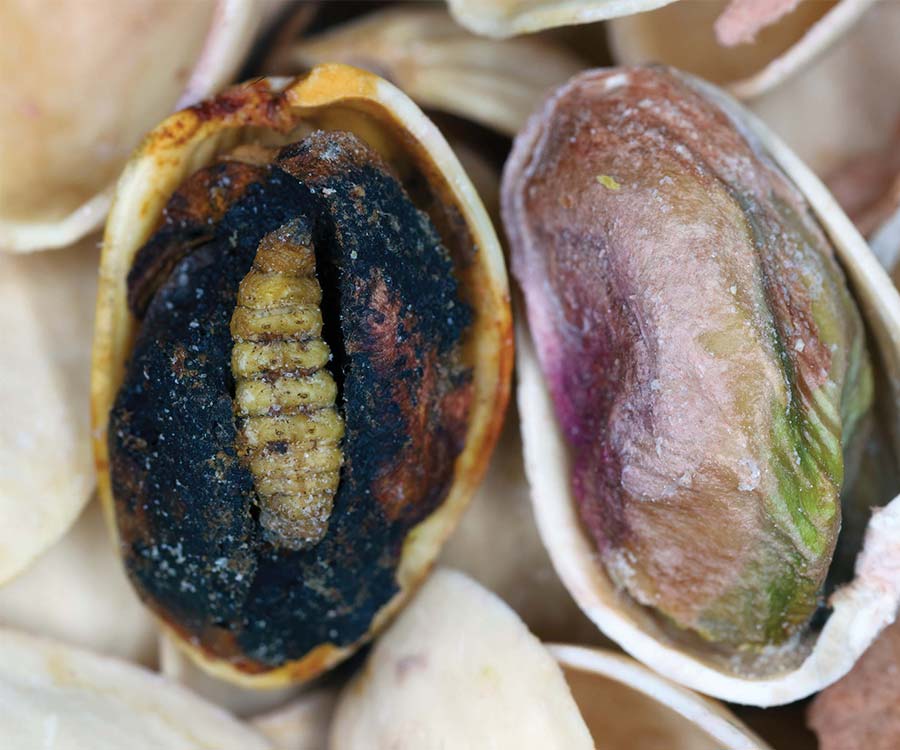
Navel orangeworm (NOW) continues to dominate pest concerns among nut growers, according to new survey data, with pressure intensifying sharply heading into 2026.
About 64% of respondents identified navel orangeworm as their top concern for 2026, up from 34% the previous year. In 2025, 60% of growers reported that NOW was their most troublesome pest, underscoring its persistent and growing impact.
This pest has held the top spot for consecutive years, underscoring it as a long-term, high-priority management issue.
But what’s changing is the strength of the second tier.
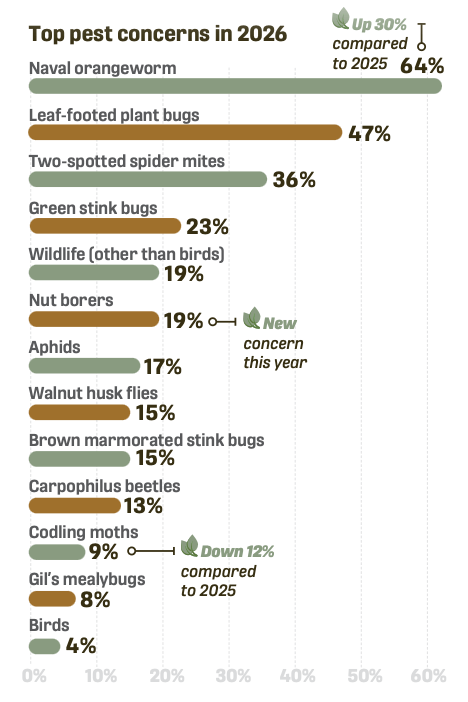
Leaf-footed plant bugs remain a significant secondary concern, affecting nearly half of respondents. About 49% said the pest was troublesome in 2025, and 47% expect it to remain a problem in 2026. That marks a substantial increase from 21% in 2025 projections, signaling a sustained and possibly expanding issue rather than a one-season spike.
Two-spotted spider mites are also emerging as a bigger concern. Roughly 31% of growers reported mite problems in 2025, while 36% identified them as a concern for the 2026 season. That figure is up from just 13% the previous year, indicating mites are quickly turning into a larger production challenge.
Other pests showed mixed trends. Concern over green stink bugs rose from 13% to 23%, supporting a broader pattern of increasing plant bug and stink bug pressure. Meanwhile, aphid concerns declined from 27% to 17% and codling moth concerns dropped sharply from 21% to 9%, suggesting improved control measures or shifting grower priorities.
Together, these results show that while one pest dominates, growers are managing a layered pest environment that requires multiple strategies.
Wildlife remains a persistent challenge
Wildlife continues to be a significant concern, with birds, squirrels, deer and other vertebrate pests cited both in survey selections and open-ended responses.
Growers specifically called out squirrel control as an ongoing issue, reflecting the limited tools available to manage these pests compared to traditional insect pressures.
Disease pressure remains steady, widespread
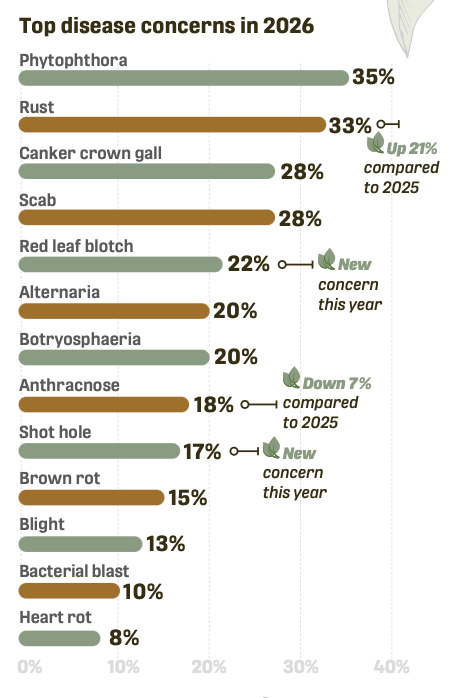
Disease concerns remain more fragmented, with no single issue dominating the landscape. Phytophthora leads 2026 disease concerns at 35%, nearly doubling from 18% the previous year. Rust follows closely at 33%, up from 12%, marking one of the most significant year-over-year increases among diseases.
Canker crown gall and scab each registered concern levels of 28%, with scab rising from 17% in 2025. Alternaria declined slightly from 25% to 20%, indicating it remains relevant but less urgent compared to other diseases.
This distribution suggests growers are navigating a complex disease landscape that may vary by region, crop type or environmental conditions. No single disease defines the season, making comprehensive disease management coverage especially important.
Emerging issues gaining attention
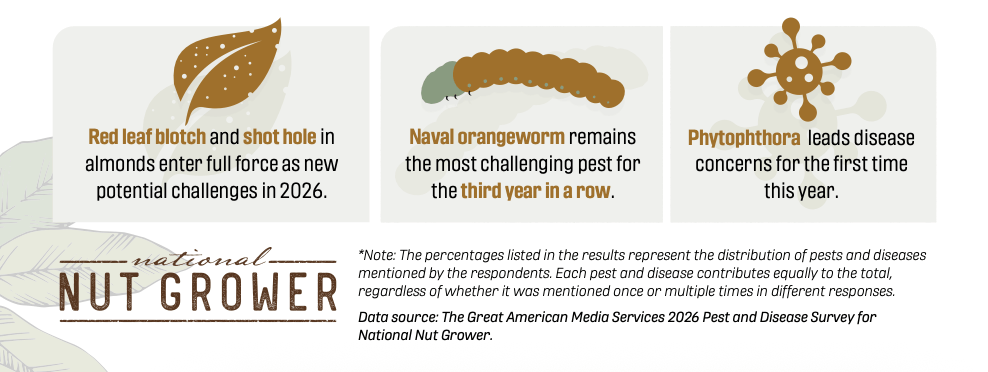
While top concerns remain consistent, the survey points to emerging challenges. Nut borers appeared as a newer pest concern, while red leaf blotch and shot hole in almonds were repeatedly mentioned in open-ended responses.
These signals suggest that the pest and disease landscape is evolving, requiring growers to stay vigilant and adapt quickly.
“I’m interested in the best products available right now, along with guidance on preventing pests and diseases before they become a problem.”
Growers seek practical, cost-effective solutions
Survey respondents also highlighted a strong demand for practical, research-driven guidance. Open-ended responses frequently called for current university research, product performance data, application timing, integrated pest management strategies and cost-effective materials. Many also emphasized the need for practical, actionable guidance and clearer disease-prevention recommendations.
Growers continue to value in-depth print coverage and indicated a strong preference for receiving timely updates through newsletters and pest or disease alert emails — reinforcing the importance of rapid, accessible communication.
FAQ
What was the top pest concern in the 2026 survey?
Navel orangeworm was identified as the top pest concern by 64% of respondents.
Which pest pressures increased heading into 2026?
Leaf-footed plant bugs, spider mites and green stink bugs all showed increased concern levels.
What wildlife issues did growers report?
Growers cited birds, squirrels, deer and other vertebrate pests, with squirrel control highlighted as a challenge.
Which diseases showed the largest increases?
Phytophthora and rust both increased substantially compared to the previous year.
What type of information are growers seeking?
Growers want practical guidance, university research, product performance data and disease-prevention recommendations.