

H-2A use hits record levels showing ongoing labor issues
Farm Bureau data shows H-2A worker requests surpassed 400,000 in FY 2025 as growers faced ongoing labor shortages, rising costs and workforce challenges. See what this means for growers.





Key takeaways
- H-2A worker requests exceeded 400,000 in FY 2025.
- H-2A certifications increased by 13,358 positions year over year.
- Use of the H-2A program has risen 185% over the past decade.
- Growers continue to report difficulty finding domestic seasonal labor.
- Rising wages, compliance costs and administrative complexity are affecting profitability.
- Many growers are adopting mechanization and operational changes to address labor shortages.
Seasonal labor shortages continue to squeeze U.S. specialty crop growers, pushing reliance on H-2A guestworkers to historic levels.
According to recent American Farm Bureau Federation data, more than 400,000 workers were requested in fiscal year 2025 (October 2024 to September 2025), and H-2A certifications grew by 13,358 positions over the previous year. Over the past decade, H-2A use has increased 185%, reflecting the ongoing gap between available domestic workers and the seasonal workforce needed to harvest fruits, vegetables, nuts and other specialty crops.
Growth, regional reliance and rising costs
Reporting from the Farm Bureau shows that nearly half of all H-2A certifications in FY 2025 were concentrated in Florida, Georgia, California, Washington and North Carolina, highlighting that certain states remain particularly dependent on foreign seasonal labor.
While the program continues to be essential, it carries growing financial and administrative costs. Growers must meet higher wage requirements, provide housing and transportation, and navigate complex application processes, all of which can strain farm budgets. The combination of rising demand and administrative complexity underscores the delicate balance growers face: securing enough labor to complete harvests while managing costs that can approach or exceed profitability thresholds.
The historic request for more than 400,000 workers illustrates the persistent challenge of finding domestic labor, even as the H-2A program expands. Year-over-year growth in certified positions demonstrates that, while the program provides critical support, growers continue to face a significant labor gap.
Grower experiences mirror national trends
National trends in H-2A use are reflected in grower experiences on the ground.
National Nut Grower’s 2025 Labor Survey found that nearly 80% of respondents reported difficulty securing adequate seasonal labor, highlighting the ongoing gap between available domestic workers and orchard needs.
More than half of respondents relied on H-2A workers in 2025, while nearly a third noted rising program costs that are affecting profitability.
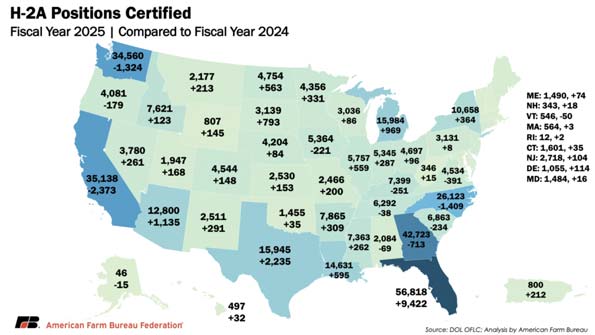
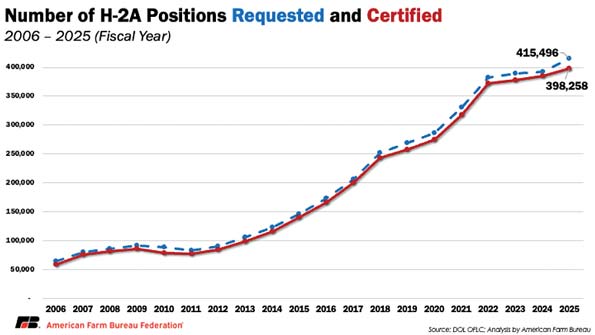
analysis by American Farm Bureau.
Even when labor was available, higher wages and compliance with regulations were shaping operational decisions. One-quarter of growers who did not secure enough help reported leaving at least 30% of their crop unharvested. While only 4% of respondents currently use the H-2A program, nearly 35% of those who have used or considered it said recent wage rules influenced their decisions about participation. About two-thirds plan to continue with the program, though one-third are considering reducing or discontinuing use, citing administrative complexity as a key challenge — nearly 70% described the legal process as “somewhat difficult” or “very difficult.”
To adapt to these pressures, growers are pursuing multiple strategies. Mechanization is increasingly used for harvesting, pruning and irrigation management, while others adjust harvest schedules, reallocate acreage or take on more work themselves. Some are leaning on local seasonal labor or interns, and a small portion are considering downsizing operations entirely. These operational adjustments show how labor availability and cost directly shape orchard decision-making, from daily staffing to long-term planning and investment.
Looking ahead
With domestic labor in short supply, nut growers will continue to rely on H-2A workers and need to plan ahead to keep harvests on track.
Insights from FY 2025 Farm Bureau data and the National Nut Grower 2025 Labor Survey show that operations that adjust crop schedules, adopt mechanization and closely monitor labor trends are better positioned to sustain harvests, maximize efficiency and maintain profitability despite ongoing labor challenges.
FAQ
What is the H-2A program?
The H-2A program allows U.S. agricultural employers to hire temporary foreign workers when domestic labor is unavailable.
How many H-2A workers were requested in FY 2025?
More than 400,000 workers were requested during fiscal year 2025.
Why are growers relying more on H-2A labor?
Persistent shortages of available domestic seasonal workers continue to drive demand.
What challenges are associated with the H-2A program?
Growers cite rising wages, housing and transportation requirements, and administrative complexity.
How are growers adapting to labor shortages?
Many are using mechanization, adjusting harvest schedules, reallocating acreage and seeking alternative labor sources.