

Study finds rising heat drives severe Western U.S. droughts
Scientists have found that rising temperatures linked to climate change have intensified droughts across the western U.S.





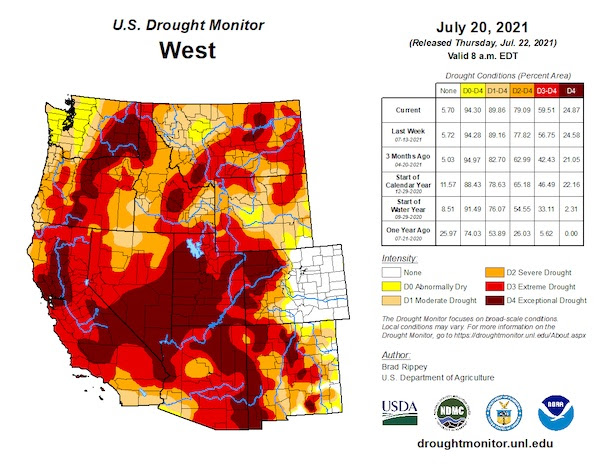
Scientists have found that rising temperatures linked to climate change have intensified droughts across the western U.S., transforming a moderate drought from 2020 to 2022 into an “exceptional” event, according to new research by scientists from UCLA, NOAA and the Cooperative Institute for Research in Environmental Sciences (CIRES).
The study, published in Science Advances, revealed that increased evaporative demand — often called the “thirst of the atmosphere” — has been a primary driver of western droughts over the past two decades, surpassing precipitation deficits.
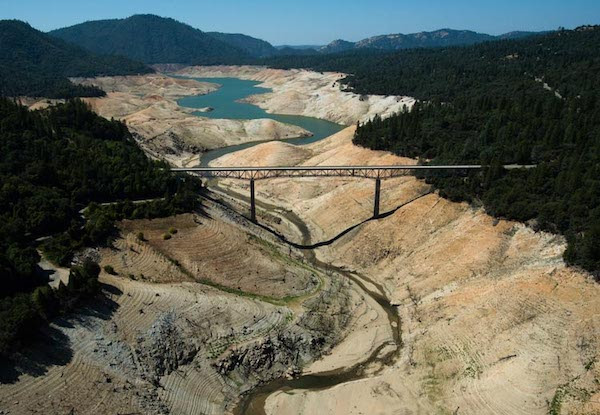
This photo shows California’s largest reservoir, Lake Oroville, nearly dry on August 19, 2014. Photo courtesy of California Department of Water Resources.
Researchers attributed 61% of the 2020-2022 drought’s severity to evaporation, with only 39% attributed to a lack of rainfall.
“For generations, drought has been associated with drier than normal weather,” said Veva Deheza, director of NOAA’s National Integrated Drought Information System and a co-author of the study. “This study further confirms we’ve entered a new paradigm where rising temperatures are leading to intense droughts with precipitation as a secondary factor.”
The scientists analyzed observational data over a 70-year period to differentiate between “natural” droughts, driven by typical weather variations, and those intensified by human-driven climate change. They found that climate change has been responsible for 80% of the increase in evaporative demand since 2000, with that figure rising to over 90% during drought periods.
“Research has already shown that warmer temperatures contribute to drought, but this is, to our knowledge, the first study that actually shows that moisture loss due to demand is greater than the moisture loss due to lack of rainfall,” said Rong Fu, professor of atmospheric and oceanic sciences at UCLA and lead author of the study, which was published in Science Advances.
The findings also indicate a shift in drought frequency and severity. According to model projections, extreme droughts like the one in 2020-2022 could become common by the late 21st century, occurring as often as every six years. This could mark a significant change from historical drought patterns.
“Even if precipitation looks normal, we can still have drought because moisture demand has increased so much, and there simply isn’t enough water to keep up,” Fu said. “The only way to prevent this is to stop temperature increases, which means we have to stop emitting greenhouse gases.”
The study was supported by NOAA’s National Integrated Drought Information System and the Climate Program Office and the National Science Foundation.