

Rethinking soil data to improve nutrient efficiency and decision-making
Soil and tissue sampling help growers optimize fertilizer use and improve yields. Explore how data-driven decisions are reshaping nutrient management.





Key takeaways
- Soil sampling is common, but interpreting results remains a challenge
- Nutrient availability matters as much as nutrient presence
- Combining soil and tissue sampling improves decision-making
- Data-driven programs can reduce fertilizer use without lowering yields
- Growers are shifting toward more precise, flexible application strategies
Soil sampling has long been standard practice in tree nut production. But for many growers, the real challenge is not collecting the data — it’s knowing what to do with it.
“Growers take a soil sample, get the report back and say, ‘OK, we did it,’” said Dylan Rogers, a sales account manager for AgroLiquid. “But the real value is in understanding what that data is telling you over time.”
As input costs rise and environmental pressures increase, more growers are taking a closer look at how that data can guide decisions rather than repeating the same approach year after year.
Looking beyond nutrient levels
One of the biggest challenges, Rogers said, is that soil tests are often interpreted at face value.
“It’s not just about how much of a nutrient is in the soil,” he said. “It’s about whether the tree can access it.”
A field may show adequate potassium levels, for example, but elevated sodium can interfere with uptake. In that case, the nutrient is present but not available to the crop.
That is why understanding how nutrients interact in the soil is just as important as knowing the numbers themselves.
Turning data into action
AgroLiquid uses soil and tissue sampling together to guide product selection and application strategy at the field level. Rather than relying on a fixed program, growers can adjust rates, timing and inputs based on the data.
Tissue sampling helps confirm whether nutrients from fertilizer applications are actually reaching the plant throughout the season.
“That’s how you close the loop,” Rogers said. “You can track tissue levels during the year and make sure what you’re applying is actually getting into the tree.”
Long-term field data from AgroLiquid trials suggest that approach can lead to lower overall fertilizer use without sacrificing yield. In a six-year almond trial in California, AgroLiquid’s program, which included products such as Pro-Germinator and Kalibrate, used significantly less phosphorus and potassium. It applied 48 pounds and 24 pounds per acre, respectively, compared to 200 pounds of phosphorus and 135 pounds of potassium in a conventional program. Nitrogen use was also lower, at 197 pounds per acre versus 266 pounds.
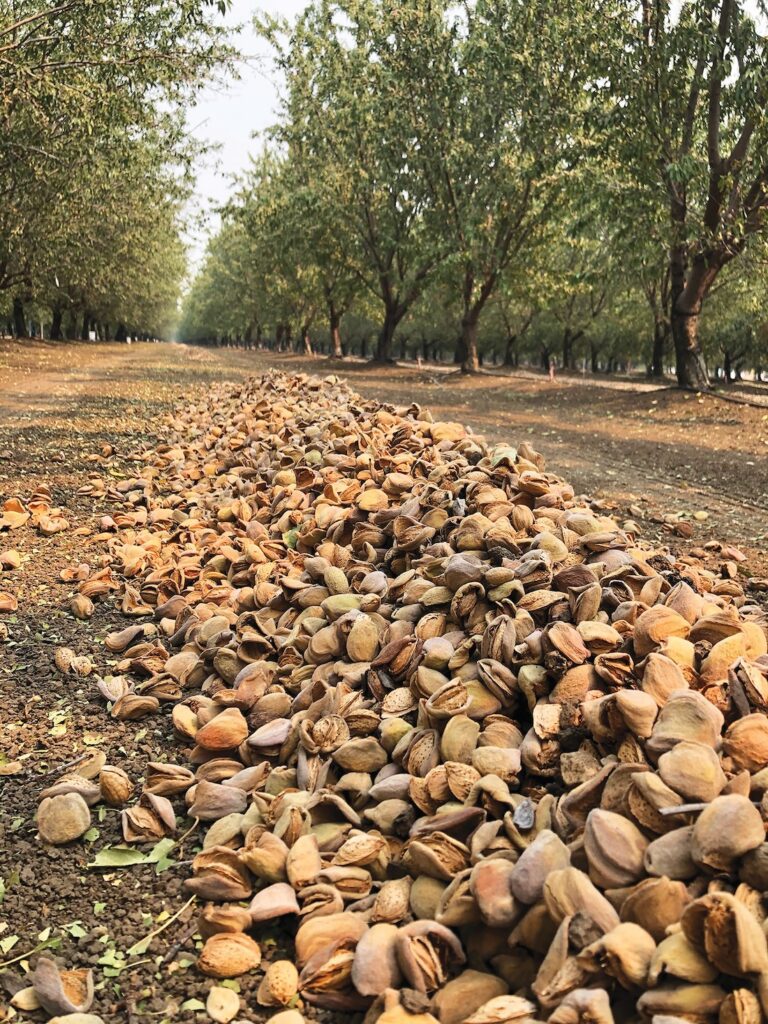
Despite those reductions, average yields in the trial were higher, at 2,841 pounds per acre compared to 2,679 pounds under the standard program, a difference of 162 pounds per acre annually.
For growers, that kind of data can make it easier to rethink assumptions about how much fertilizer is actually needed and whether different product formulations or application strategies could improve efficiency.
“In many cases, you end up applying less fertilizer, and that can be uncomfortable at first,” Rogers said. “But when you track it through tissue sampling and see that your levels are staying where they need to be, that’s when it starts to make sense.”
Efficiency under pressure
Efficiency has become a bigger focus across the industry, especially as growers navigate rising costs and tighter regulations.
Nitrogen management is one example. Nutrients can be lost through leaching after rainfall or irrigation and through volatilization in certain soil conditions.
Rogers said AgroLiquid’s approach is focused on improving how nutrients behave in the soil, with product formulations designed to help keep nutrients available in the root zone longer and better aligned with crop demand.
The goal is to make every application count.
Adjusting throughout the season
Advances in fertigation have also changed how growers approach timing. Instead of applying large amounts of fertilizer upfront, more operations are shifting toward smaller, more frequent applications.
That approach gives growers the flexibility to adjust both rates and product choices based on current conditions rather than sticking to a fixed plan.
For permanent crops such as almonds, walnuts and pistachios, that flexibility matters.
“We’re always fertilizing next year’s crop,” Rogers said. “What you do this season is going to impact what you see next year.”
Balancing tradition and change
Shifting away from established practices is not always easy. Many growers have relied on the same fertility programs for years.
But that conversation is starting to change as more data becomes available, including multi-year trials from companies such as AgroLiquid.
Those results suggest that more targeted nutrient programs, supported by specific product technologies and data-driven adjustments, can maintain and in some cases improve yields while reducing overall inputs.
For growers, the takeaway is not necessarily to do more. It is to be more intentional.
“It’s about understanding your soil, understanding your data and making decisions based on that,” Rogers said.
FAQ
Why isn’t soil sampling alone enough?
Because it shows nutrient presence, not whether plants can access those nutrients.
What is tissue sampling used for?
To confirm that nutrients applied through fertilizer are actually reaching the plant.
Can growers reduce fertilizer use without losing yield?
Yes, data from trials suggests targeted programs can lower inputs while maintaining or improving yields.
Why are growers changing fertilizer strategies?
Rising costs, regulations and better data tools are driving more precise approaches.
What is fertigation?
A method of applying fertilizer through irrigation systems in smaller, timed applications.
Photos courtesy of AgroLiquid.