

Anthracnose in Georgia pecans
Many varieties confirmed with anthracnose this year are high-input varieties, which received pre-pollination sprays. But why are growers seeing widespread anthracnose at this time?






Speaking with pathologist Jason Brock, the few samples tested for bacterial leaf scorch this season were negative. Insects were present early this year with dry conditions, and some scorch was attributed to mites. Since late July, however, the lab has confirmed anthracnose to be the scorch and subsequent leaf shed in many orchards.

Leaf drop from anthracnose is a common symptom. Photo: University of Georgia
I, personally, have seen three different cases of anthracnose in the last week and a half in different parts of East Georgia. I’ve also noticed it on many different varieties. Anthracnose is a fungal pathogen caused by Glomerella cingulata, occurring on both the foliage as well as the fruit. It must be noted that in Georgia, fruit infection has been very little to none in the last 10 years. A very common field diagnosis is not only the ‘scorch’ on the leaves, but leaves ‘raining down’ from trees. Leaf fall is often observed while standing under infected trees.
Background
The infection period of anthracnose is actually in the spring, sometime between budbreak and as late as July. Many growers ask, “Do I need to spray more during pre-pollination?” Ideally, we use less pre-pollination sprays – if conditions allow – knowing that we cannot reduce nut scab sprays. However, many varieties confirmed with anthracnose this year are high-input varieties which received pre-pollination sprays every two weeks. These sprays would certainly cover the infection period of anthracnose. If this is the case, why are we seeing widespread anthracnose at this time?
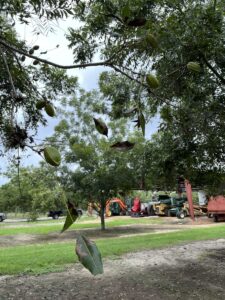
These nuts will not open at harvest. This is a common site where leaves shed, leaving nuts unable to fill out and later split open. Photo: University of Georiga
Anthracnose is known as a stress pathogen. After infection, anthracnose fungus goes through a long latent period. It takes many weeks for the symptoms of anthracnose to actually appear. During this latent period, a stress in the tree ultimately initiates symptom expression. It could be physiological stress or possibly environmental stress. It has also been noted that significant crop load may contribute to anthracnose development. In the UGA Plant Disease Clinic, Jason has diagnosed anthracnose in many crops this season. From this perspective, we know conditions for anthracnose in 2022 have been favorable.
Summary
The most important thing to remember is that anthracnose infects our orchards to some degree each year, but the symptoms are not always expressed. There must be some stress for the anthracnose to fully develop through its incubation period.
Due to the widespread anthracnose across the state, in other crops and in multiple varieties of pecan, there is likely a common environmental and/or physiological stress causing the infection to develop into scorch symptoms in 2022. The May and June heat may be an environmental stress. The large crop we currently have may be a physiological stress.
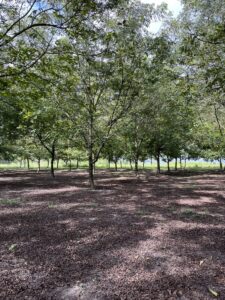
Over-crowded ‘Desirable’ orchard with significant leaf drop. A heavy crop with lack of sunlight is a major contributor to this anthracnose symptom expression. Photo: University of Georgia
Management
If you see anthracnose year to year, a cultural practice-induced stress may be the cause. Some cultural tips include:
- Managing crop load by mechanical shaking or hedging will help with crop stress.
- Maintain a 2:1 ratio of nitrogen and potassium in leaves.
- Make sure trees are not receiving too much water or too little water. From April to July, we recommend most orchards irrigate every other day as opposed to every single day so soils do not become anaerobic.
– Andrew Sawyer, University of Georgia, with contributions from Jason Brock, University of Georgia, and Lenny Wells, University of Georgia