

Blue Diamond Growers reports on Central Valley nut orchards ahead of 2026 bloom
Blue Diamond Growers reports on winter conditions in Central Valley nut orchards ahead of the 2026 bloom. Check out the latest updates.





2 minute read

As the 2026 bloom approaches, California’s nut growers are finishing winter orchard tasks amid one of the most unusual seasons in recent memory.
According to the latest crop progress report from Blue Diamond Growers, these observations summarize conditions leading up to the bloom, with weekly bloom updates expected to begin the week of February 9, 2026.
 While early-season rainfall put most locations above normal, the dry stretches that followed have brought cumulative precipitation near or slightly below typical levels for this time of year, according to the crop progress report.
Snowpack levels in the Sierra Nevada watershed have also been uneven. Storm systems largely delivered snow at higher elevations, with the southern Sierra receiving heavier accumulations than the north. As of the report, the Sierra snowpack stands at 43% of normal in the north, 60% in the central region and 78% in the southern Sierra, according to Blue Diamond Growers.
While early-season rainfall put most locations above normal, the dry stretches that followed have brought cumulative precipitation near or slightly below typical levels for this time of year, according to the crop progress report.
Snowpack levels in the Sierra Nevada watershed have also been uneven. Storm systems largely delivered snow at higher elevations, with the southern Sierra receiving heavier accumulations than the north. As of the report, the Sierra snowpack stands at 43% of normal in the north, 60% in the central region and 78% in the southern Sierra, according to Blue Diamond Growers.
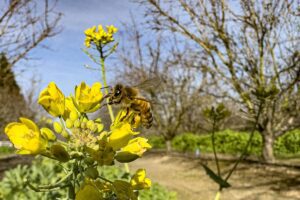 Growers who planted flowering cover crops after harvest have seen strong early growth thanks to early rains. These plants provide crucial forage for honeybees before and during bloom, anchoring them within the orchard and improving pollination efficiency.
Winter weather brings contrasts
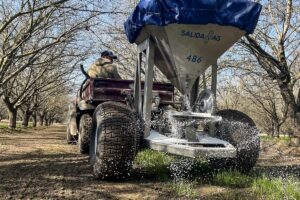
The winter of 2025–26 has been marked by extremes. Following heavy rains that interrupted harvest for many growers in 2025, the Central Valley experienced a few strong but relatively warm storms in mid-November and around Christmas. These events were punctuated by extended periods of high pressure, leaving much of the region with little to no precipitation.Fertilizer application in Stanislaus County.
Fog and orchard sanitation aid pest management
The combination of lingering soil moisture from November rains and extended high-pressure systems created persistent, dense tule fog in much of the valley. Many areas experienced up to three weeks of limited sunlight in December and January, according to the crop progress report. The fog and dry conditions, however, have provided a silver lining for orchard sanitation. Removing and destroying mummy nuts is easier under these conditions. Moisture softens the nuts’ attachment, allowing them to be shaken, windrowed and destroyed with flail mowers. According to the report, these efforts are expected to reduce navel orangeworm populations heading into the bloom.Winter orchard tasks continue
Growers have been busy training younger orchards and performing therapeutic pruning on bearing trees. Broken branches and limbs that could interfere with equipment have been removed, and shredders follow pruning crews to grind brush for on-orchard decomposition, according to the report. Soil amendment applications, including gypsum and lime to correct pH and certain fertilizers, have also been applied ahead of the bloom, setting orchards up for optimal soil conditions.Bee staging and cover crop benefits
Beekeepers have been moving hives into the Central Valley for several weeks, staging colonies in open lands before moving them into orchards. Colder mornings and foggy conditions have allowed this work to extend into early daylight hours.Flowering cover crop in Stanislaus County.