

Hedging and shredding in pecan orchards
Returning these limbs and the organic matter and nutrients they hold to the soil may help improve soil quality, and will help improve the sustainability of pecan production.





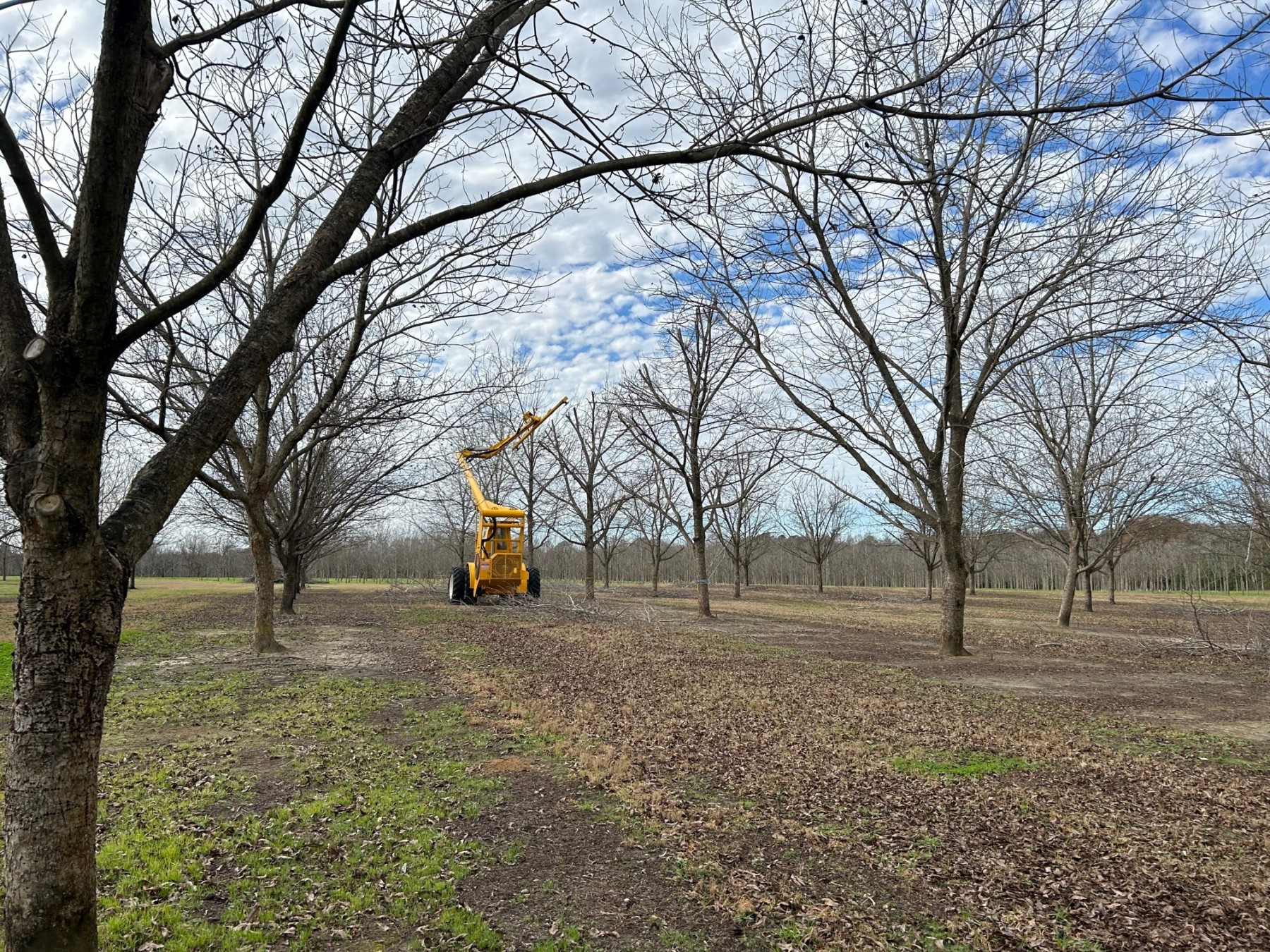
Thanks to Ben Houston for hedge pruning trees in our research orchards.
There may be a better way to dispose of limb prunings. When hedging, most of the limbs fall within the tree row middles. Returning these limbs, the organic matter and nutrients they hold to the soil may help improve soil quality and will help improve the sustainability of pecan production, which, along with the other positive environmental benefits of orchards, can and should be used a marketing tool for pecans.
However, one of the concerns with this process is whether or not the shreddings will interfere with the harvest process and cause issues in the cleaning plant. I don’t think they will, but we plan to find out.

Thanks to Savage Equip., we were able to acquire one of these and tried it out following our hedge pruning. Cost of the shredder is around $30,000, which is not cheap, but considerably less expensive than larger equipment that does the same job. This shredder is 8 ft. wide and is essentially a super heavy-duty flail mower that can shred material up to 5 in. in diameter.

In most hedging jobs, the largest material comes down in the first cut. Subsequent cuttings would not be likely to be larger than 3.5 in. in diameter except when you cut behind the original cut. Therefore, I think it will work well for the purpose of chewing up hedge pruned limbs and leaving the shredded material on the orchard floor.
You can see below the shredded material that is left behind.

Most of the material is left in 3- to 6-in. thin ribbons of woody material. I believe this will decompose relatively rapidly in our hot, humid climate and not interfere with harvest or operations in the cleaning plant. We will be monitoring changes to the soil over time in these plots and comparing them to changes in plots where limbs are removed.
We will be investigating whether or not additional nitrogen (N) is needed to account for that used by microbes breaking down the material, but because we often apply N in the tree row — and similar studies from New Mexico indicate no additional fertilizer was required in the West where shredded limbs were left on the orchard floor — we are hopeful that will be the case here.

– Lenny Wells, University of Georgia