

Oak root fungus: rootstock considerations in 2025-2026
Learn which almond rootstocks resist oak root fungus and ensure orchard survival. Explore Krymsk 86, Rootpac R, Magnus and other options.





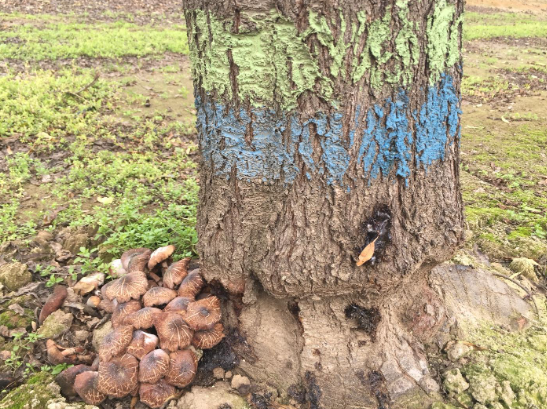
Rootstock is the key management tool in a very limited toolbox against this disease. Rootstocks with plum parentage are the most likely to have some level of ORF resistance. However, the plum in these same rootstocks can lead to incompatibility and, in some cases, less than desired vigor.
Marianna 2624 was California’s historic answer to orchards with a history of ORF. However, Marianna 2624 is incompatible with some important standard almond varieties including most critically Nonpareil and Butte. In addition to incompatibility, the rootstock suckers profusely, requiring costly maintenance.
In lieu of Marianna 2624 on ORF ground, growers have largely shifted to planting with Krymsk 86 (plum x peach) rootstock. This newer rootstock confers superior anchorage, and vigor compared to Marianna 2624. Although Krymsk 86 is not immune to ORF, and field data on its level of resistance is still limited. However, grower and UC Farm Advisor observations, as well as USDA lab data, all indicate that it offers higher survival rates against ORF compared to the historic Sacramento Valley standard Lovell peach rootstock.

Unfortunately, no rootstock is perfect, and Krymsk 86 is no exception. Krymsk 86 is one of the most sensitive rootstocks to nematodes (especially root knot) and salts (Cl, Na, B, etc.). In addition, much like Marianna 2624, K86 doesn’t get along with every almond (scion) variety. There’s the yellowing Krymsk 86 malady which has appeared periodically in young Monterey trees, often induced by excessive spring rain.
More recently, orchards planted with new self-fertile almond varieties Independence and Shasta have shown “failure to thrive’” with Krymsk 86. There is also some early evidence of Krymsk 86 incompatibility symptoms with new self-fertile varieties Lassen and Pyrenees. However, there are other self-fertile varieties that to-date appear to be compatible with Krymsk 86, including Yorizane, Parpareil (new USDA release) and Early Bird.
Which other rootstocks may hold promise?
Magnus, previously known has Hybrid 17 (peach x plum) is a new Sierra Gold rootstock that is purportedly higher vigor than Krymsk 86. A Butte County grower is early in testing the rootstock in their ORF hot spots, and it is also being tested by Roger Duncan in Stanislaus County. It is too early to know if this rootstock will have some resistance against ORF.
What doesn’t work?
Following the problems with Independence and Shasta on Krymsk 86, some Sacramento Valley growers have instead planted those same varieties on Viking (interspecific hybrid of peach, almond, apricot and plum; only 1/8th plum). Very early results from Roger Duncan’s trial indicate that Viking may be highly susceptible to ORF. Peach (Lovell, Nemaguard),and peach/almond hybrids (Hansen 536, Bright’s Hybrid 5, SG1, etc.) are not ORF resistant.
The bottom line
If you are concerned about ORF and not willing to deal with Marianna 2624, Krymsk 86 is the alternative we have the most evidence in favor of. The selection of Krymsk 86 then adds the complication of potentially eliminating certain self-fertile varieties from being planted on that ground because of rootstock incompatibility concerns.
We will continue to vet Krymsk 86, along with Rootpac R, Magnus and newer alternatives both for resistance to ORF, as well as for compatibility with an ever-growing list of new self-fertile varieties.
— Luke Milliron, UCCE Farm Advisor, Butte, Glenn and Tehama Counties; Roger Duncan, UCCE Farm Advisor Emeritus, Stanislaus County