

Pecan phylloxera update for Georgia
Wart-like galls on pecan leaves can be a sign of pecan leaf phylloxera, a pest that needs to be controlled at budbreak.





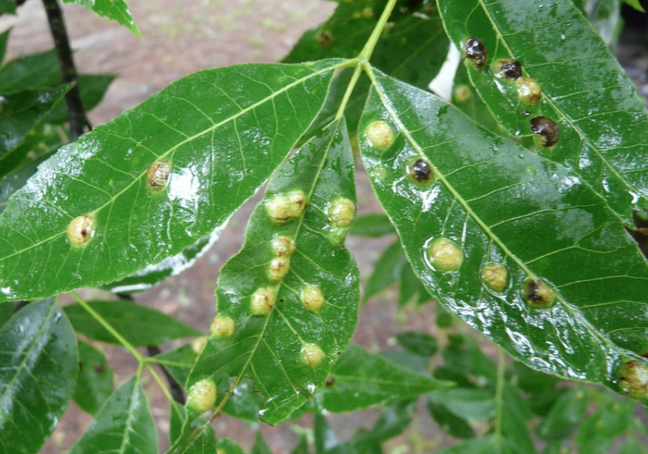
These symptoms let us know that pecan phylloxera are present in the orchard and actively feeding.
Although there are a few different species of phylloxera, I am discussing the pecan leaf phylloxera, Phylloxera notabilis, as it is most commonly seen in our orchards. The pecan leaf phylloxera is a tiny aphid-like insect that feeds on the foliage of mature pecan trees. While we most commonly observe this pest on mature trees, it can also be found feeding on nursery and young trees.
Overwintering eggs will begin to hatch during the first week of April and continue until the first of May. The newly hatched stem mothers will crawl to the expanding leaves, where they settle down to begin feeding. The feeding causes the rapidly growing gall tissue, which will then enclose the stem mother within the gall. By mid-April the stem mother will mature and begin to lay eggs inside the gall. The gall will enlarge overtime as more phylloxera hatch inside, and by mid-May the matured phylloxera emerge. They will then crawl to another spot on the leaf to begin a new generation.

Pecan leaf phylloxera viewed by dissecting microscope inside a leaf gall. Photo: Andrew Sawyer, University of Georgia
Light populations are most likely going to be of little consequence. However, each gall results in dead leaf tissue and numerous galls can cause premature leaf shedding. Phylloxera become troublesome in an orchard when left alone for many years. If the species of Phylloxera becomes “stem phylloxera,” damage can become more serious.
If your orchard is continually infested with phylloxera, your trees should be sprayed right at budbreak. This timing is critical because once galls are formed, no insecticide can penetrate the leaves.
Imidacloprid was drenched around infested pecan trees in December, January, February and March with no difference in control for phylloxera. Though imidacloprid is effective on pecan phylloxera, these large trees are not able to transfer the insecticide to the buds before budbreak. This is why our best option is a foliar spray of imidacloprid at budbreak. This timing is difficult as pecan varieties experience budbreak at different times.
With this being said, leaf phylloxera is typically of minor economical importance in our orchards in most situations. Another species known as the pecan stem phylloxera can be a more severe and damaging pest, but unlike the pecan leaf phylloxera, it is not commonly observed.
Galls on mature pecan leaves from pecan leaf phylloxera. Once galls form, insecticide cannot control the insects. Photo: Andrew Sawyer, University of Georgia