

UC Cooperative Extension’s latest insights on almond orchard management
The University of California Agriculture and Natural Resources Cooperative Extension has released its latest newsletter, highlighting critical pre- and post-harvest management practices for almond orchards.





The publication highlights critical pre- and postharvest management practices for almond orchards.
The newsletter edition, penned by orchard advisors Jaime Ott, Franz Niederholzer, Katherine Jarvis-Shean, and Luke Milliron, addressed key issues such as pest control, crop progress and harvest strategies.
Pest and disease management
The newsletter underscored the importance of vigilant pest management throughout the summer. Navel orangeworm (NOW) and peach twig borer (PTB) pose significant threats, necessitating timely edge sprays when the first sound nuts reach hull split.“Monitor for NOW and PTB, and consult with your PCA for effective management,” advised Niederholzer in the newsletter.
To mitigate hull rot risks exacerbated by wildfire smoke and high humidity, regulated deficit irrigation (RDI) is recommended. This technique promotes even hull split and aids in controlling both NOW and hull rot.
The advisors also stressed the importance of leaf sample analysis in July to fine-tune nutritional programs and anticipate potential toxic element accumulation.
Crop progress and harvest anticipations
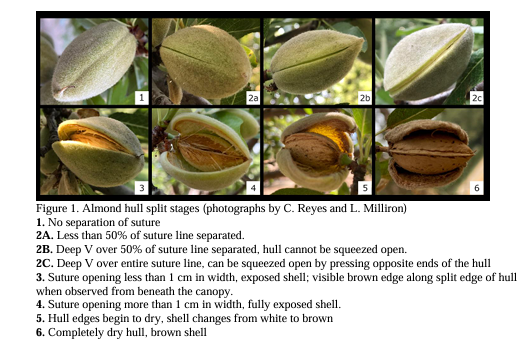
As harvest approaches, timely and precise preparations are vital. The advisors recommended beginning the harvest when all nuts in the orchard reach at least Stage 2C of hull split.For post-harvest practices, quick irrigation resumption is crucial to minimize tree water stress.
The newsletter also suggested assessing hull rot and shaker damage, and considering fall applications of zinc and boron based on plant tissue analysis results.
The newsletter’s detailed insights provide a comprehensive guide for almond growers to optimize orchard health and yield. For more information, read the full details in UC Cooperative Extension’s newsletter.