

UGA to growers: Be on the lookout for ambrosia beetle
Whether a large outbreak or not, ambrosia beetle attacks will occur at some extent on newly planted pecan trees.





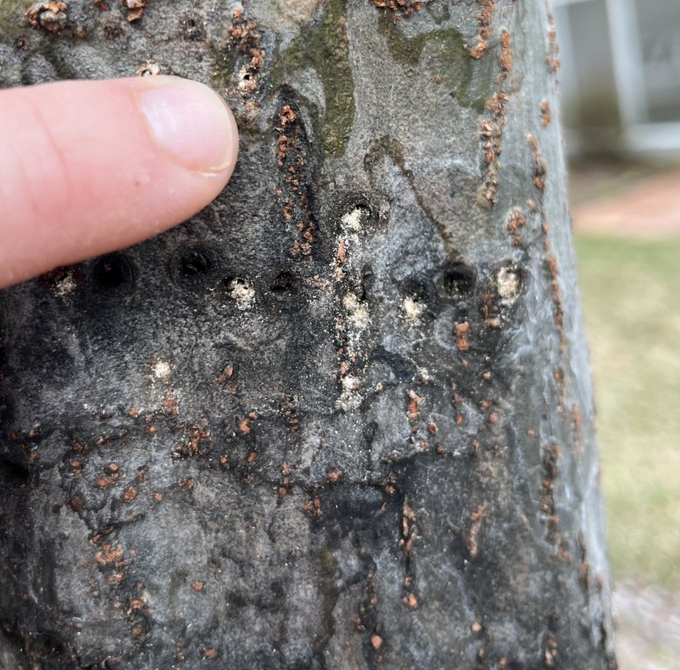
It looks like Georgia growers are seeing the first flight of ambrosia beetle. Apurba Barman, University of Georgia entomologist, has seen good hits on new trials in Ware County and Brooks County. East Georgia is having consistent flights now (Feb. 20).There are two particular groups of pecan growers that need to be aware of ambrosia beetle flights:
- Small – medium size orchards
- Pecan trees under 4 years old

5-year-old Elm tree planted in dark, rich soil hit by ambrosia beetles on February 20, 2023 for the first time ever. The sawdust from the beetles is coming out of holes first created by a Sap Sucker bird. Photo: University of Georgia
Because trees sold from ornamental tree nurseries are vulnerable to ambrosia beetle attacks, we can be attuned to statewide outbreaks. Pecan trees are considered vulnerable in their first few years of growth. The ambrosia beetles live in wooded areas and respond to stress chemicals released from newly planted trees.
Female beetles can fly as soon as air temperatures hit 60° F. Our temperatures have been up and down, but middle February generally sees first flights in deep South Georgia.
Ambrosia Beetle Management
The best management approach is this:- Set ambrosia beetle traps to determine first flight
- Once hits are observed on traps, scout pecan trees
- Spray pecan trees with bifinthrin or permethrin every 7-10 days
- Continue monitoring traps adding ethylene into drill holes once a week
Spray interval research
In our original management research, we compared painting trees with white latex paint with spraying pyrethroids. We chose 7-day interval applications knowing the pyrethroid would not stay on the tree long. Statistically, research showed the best options was either 1.) applying pyrethroid insecticide to painted trees, or 2.) spraying pyrethroid at 7-day intervals.Knowing 7-day interval spray is a lot for growers to come back and spray individual trees, Barman and Sawyer are going to test if this interval can be extended to 14 days instead of 7 days. We are also not sure whether we need to use full labeled rate of pyrethroid or if lower rate can do the job. Through this particular experiment, we are also going to evaluate how low and high rates of pyrethroid application impact ambrosia beetle control. The primary goal of this experiment is to reduce use of insecticide, as well as the burden of spraying the young trees so frequently.
— Apurba Barman, entomologist, University of Georgia; Andrew Sawyer, area pecan agent, University of California